The Day the Great Communicator Stepped Into the Final Frontier
President Ronald Reagan’s Visit to the Set of Star Trek: The Next Generation
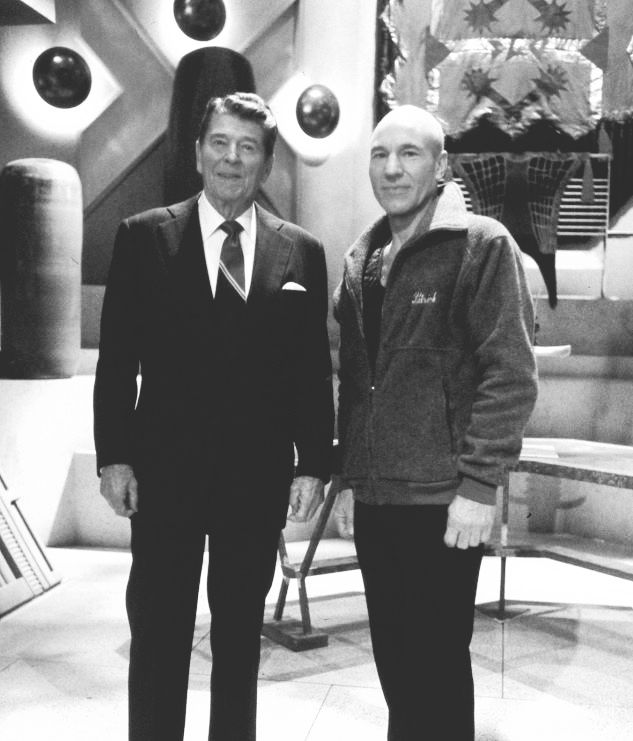
In April of 1991, two years after leaving the Oval Office, former President Ronald Reagan — a Hollywood actor turned leader of the free world — walked onto the Paramount Studios lot and into one of the most quietly magical crossovers in pop culture history.
The Great Communicator was about to step into the final frontier.
Reagan had come to visit the live set of Star Trek: The Next Generation, which was deep in production on the Season 4 finale, “Redemption” — an episode that also marked the show’s milestone 100th installment. The visit wasn’t a coincidence or a last-minute arrangement. It had been quietly orchestrated through a decades-old Hollywood friendship between Reagan and legendary Paramount producer A.C. Lyles, a man who had been a fixture at the studio since 1928 and who had known Reagan since the 1940s. Lyles, often called “Mr. Paramount,” served as the studio’s unofficial ambassador of goodwill and had long acted as a bridge between Hollywood and the White House during the Reagan years.
The tour began at Stages 8 and 9, home to the show’s standing sets — including the iconic bridge of the U.S.S. Enterprise — before moving to Stage 16, Paramount’s so-called “Planet Hell” stage, where the crew was filming the dramatic Klingon High Council chamber sequences. The set was crawling with actors in full Klingon warrior makeup and prosthetics, a sight that would have startled most visitors.
Not Reagan.
When someone asked the former president what he thought of the fearsome-looking Klingons, he didn’t miss a beat. With a grin, he delivered a line worthy of his reputation: “I like them — they remind me of Congress.” The entire stage erupted in laughter.
Word of Reagan’s arrival had spread quickly. Producer Rick Berman and writer Michael Piller came over from their offices to greet him. Brent Spiner — the actor behind the beloved android Data — wasn’t even on the call sheet that day, but showed up anyway, unwilling to miss a chance to witness history.
And then came the moment that would stay with everyone who saw it.
Gene Roddenberry — the ailing creator of Star Trek, frail and relying on a cane — made his way over on his motorized cart to welcome Reagan personally. He settled into his director’s chair and waited as the presidential party approached. As Roddenberry began to rise, his cane slipped from his hand and clattered to the stage floor.
Without hesitation, Reagan — nearly ten years Roddenberry’s senior, at eighty years old — stepped forward, knelt down on one knee, and picked up the cane, handing it back to the visibly moved creator. Roddenberry later reflected on the gesture with characteristic wit and warmth: “At that moment, I felt as if I were being knighted.”
It was a small act of grace between two men near the end of their remarkable lives. Roddenberry would pass away just six months later, in October of 1991.
The visit also produced one of its most endearing moments on the Enterprise bridge. Like many VIP guests, Reagan wanted to sit in Captain Picard’s chair. But according to Patrick Stewart, while most visitors politely asked permission first, the former President of the United States simply walked over and sat down — no request necessary. After all, he had once occupied an even more famous seat.
Years later, Reagan’s eldest son Michael reflected on the visit in his 2004 book, In the Words of Ronald Reagan. He wrote that even after leaving office, his father remained fascinated by dreams of a bright future for humanity. During his time on set, Reagan chatted with Patrick Stewart and Gene Roddenberry about the show and its optimistic vision of the future — a vision that, in many ways, mirrored his own.
Standing on that starship set, surrounded by a cast and crew imagining a united Earth sailing among the stars, perhaps the old president found something that resonated deeply with his own brand of boundless optimism. It was proof that sometimes the most profound encounters between greatness and wonder don’t happen in the halls of power.
Sometimes, they happen on a Hollywood soundstage dressed up like tomorrow.